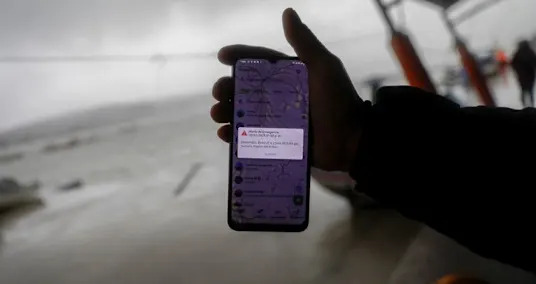
March 27 (Reuters) - Observations made by a satellite operated by the U.S. and French space agencies shortly after a strong earthquake struck off Russia's Kamchatka Peninsula last year are giving scientists a better understanding of how tsunamis originate and propagate.
The researchers said the findings may help improve understanding of future tsunamis and earthquakes at subduction zones, particularly near the ocean trench where two tectonic plates meet and one slides beneath the other. The strongest tsunamis often are generated by such quakes.
The magnitude 8.8 quake struck on July 29, 2025, triggering a tsunami that spread across the Pacific Ocean. A tsunami - a series of extremely long and powerful ocean waves - is caused by large movements of the seafloor that push water up or down, often during earthquakes or landslides that occur under water.
The NASA-CNES Surface Water and Ocean Topography, or SWOT, satellite made its observations within 70 minutes of the start of the earthquake. It observed not only the leading wave of the tsunami but also a distinct pattern of smaller waves trailing behind it. Such wave patterns had long been predicted in computer models and theoretical studies, but had been difficult to confirm with real-world observations, the researchers said.
"I believe SWOT represents a new lens for observing and studying tsunamis and their generation," said Ignacio Sepúlveda, a professor of coastal engineering at San Diego State University and lead author of the study published this week in the journal Science.
"It is also likely to improve our understanding of the physical mechanisms that generate tsunamis, including earthquakes," Sepúlveda added.
Traditional deep-ocean pressure sensors and other satellites have limitations in coverage and measurement, making it difficult to capture the full structure of the waves, especially near the trench, the researchers said. SWOT scans a wide swath of the ocean, producing two-dimensional maps of sea surface height. This allows scientists to see the shape, direction and spacing of tsunami waves in much greater detail.
Tsunamis are among the strongest and most destructive natural forces, with powerful waves radiating from a point of origin outward in all directions. These waves can cause damaging and deadly coastal flooding.
The tsunami in this study did not cause significant loss of life, but others have caused huge death tolls such as the 2004 Indian Ocean tsunami that killed some 230,000 people.
The July 2025 tsunami originated within about 10 kilometres (six miles) of the trench, the place in the seafloor where two tectonic plates intersect, the researchers found. This location could not previously be determined using traditional land-based instruments or sparse sensors on the seafloor alone.
Earth's surface is made up of immense plates that move very gradually in a geological process called plate tectonics.
The researchers found that when earthquake-caused movement extends close to the trench, it can generate shorter waves that travel more slowly and spread out over time, forming a trailing pattern behind the main tsunami front. This behaviour means that different parts of the wave move at different speeds, with longer waves moving more quickly and leading while shorter ones lag behind.
The study also showed that the strength of the trailing waves increases when earthquake movement extends closer to the trench, suggesting these waves are linked to where and how the tsunami was generated near the trench.
"This opens a new window to understand in a better way what happens with earthquakes and tsunamis near the trench," Sepúlveda said, referring to SWOT observations. "In the future, this knowledge will allow us to improve models we use to evaluate tsunami hazards in coastal communities and make them more resilient."
(Reporting by Marta Serafinko in Gdansk, Poland; Editing by Will Dunham)
LATEST POSTS
- 1
 Tatiana Schlossberg, a granddaughter of JFK, is dead at 35 after cancer diagnosis
 - 2When the moon hits your eye from your Orion ship up high, that's a 'mare'
- 3One of the best meteor showers of the year peaks at the worst possible time this week
- 4Robert Pattinson claims he's a pathological liar. What 'The Drama' star has said about his 'shtick'
- 5Lift Your Style: Famous Hairdos for Ladies




- Winter virus season so far is not too bad, but doctors worry about suffering to come
- Kona SUV: The Courageous Minimized That is Catching Hearts Around the world
- Mom finds out she has cancer after noticing something was off while breastfeeding
- Taco Bell debuts its Baja Blast pie, and the reactions may surprise you
- A definitive Manual for Picking Electric Vehicle: Decision in favor of Your Number one
- 'Wuthering Heights' trailer features Margot Robbie and Jacob Elordi in a steamy forbidden romance
- Australian State Triggers Emergency Powers Amid Fuel Crisis
- Flights canceled at 40 U.S. airports: Follow live updates as FAA cuts to air traffic take effect amid government shutdown
- What we know about the Brown University shooting suspect who was found dead, and how police linked him to the MIT killing


