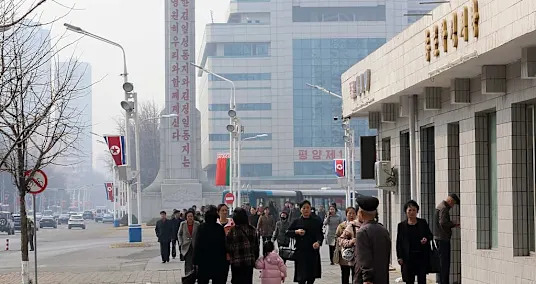
China has announced that its flag carrier, Air China, will resume direct flights to North Korea after a six-year pause, following the restoration of passenger train services between Beijing and Pyongyang.
This marks a significant step toward reopening North Korea, one of the world's most isolated nations, to the world.
Transport links between the two capitals had been suspended since the start of the Covid-19 pandemic in 2020, when Pyongyang implemented a very strict border closure.
While North Korean carrier Air Koryo already resumed flights to Beijing in 2023 and allowed Russian tour groups to visit in 2024, the return of China's air and railways are seen as a major economic milestone, as China has for decades been the main trading partner and a key source of diplomatic and economic backing for the country of 26 million people.
Before the pandemic, there were an estimated 300,000 foreign visitors in 2019, according to South Korea's Institute for International Economic Policy, and Chinese visitors accounted for 90% of all tourists to North Korea. Therefore, the long delay in resuming regular travel had surprised many regional observers.
"The reopening of these borders has been driven primarily by Pyongyang's timeline, which challenges the outdated assumption that Beijing dictates terms to a dependent client state," Seong-Hyon Lee, a visiting scholar at the Harvard University Asia Centre, explains.
Related
Nuclear ambitions complicated the relationship
Despite being Pyongyang’s primary ally, Beijing has frequently voiced disapproval over the North's persistent missile tests and nuclear ambitions. This aspect created a bumpy relationship with Pyongyang, with analysts saying that a nuclear-armed North Korea has often been something of a liability.
The diplomatic normalisation was highlighted last September, when Kim Jong Un attended a massive military parade in Beijing alongside Russian President Vladimir Putin. This was Kim's first appearance at a Chinese military display.
Lim Eul-chul, a North Korea expert at South Korea's Kyungnam University, argues that the war in Iran, in particular, increased "the need for closer coordination between the two nations".
LATEST POSTS
- 1
 Air Force made critical errors during October 7 massacre, investigator says
 - 2The most effective method to Look at Medical caretaker Compensations Across Various Clinics
- 3Charity 'feels the pinch' of higher energy prices
- 4Ryan Gosling responds to Deidre Hall's invitation to visit the 'Days of Our Lives' set: 'This is a very enthusiastic yes'
- 5More Than 110 New Species Discovered In Deep Waters Off Australia





- EU waters down plans to end new petrol and diesel car sales by 2035
- Nature carves colossal snowman in Siberia | Space photo of the day for Jan. 2, 2026
- Rights group: At least 2,500 deaths during protest crackdown in Iran
- Game theory explains why reasonable parents make vaccine choices that fuel outbreaks
- Potential Houthi threat to Red Sea shipping could further damage global economy
- Shredded cheese sold in dozens of states recalled due to potential for metal fragment contamination
- Mont Blanc road tunnel reopens to traffic after 15 weeks of repairs
- Second doctor in Matthew Perry overdose case sentenced to home confinement
- Step by step instructions to Involve Compact disc Rates for Magnanimous Giving